| |
|
PUBLIC MARKET INSIGHTS
September 2026 · Monthly Edition
Advisory · Strategy · Markets
|

|
|
|
Welcome to the September edition. This month marks five years since the amended Rule 15c2-11 compliance date reshaped the OTC market, and the lessons of that date have aged well. From there: registration fees fall sharply on October 1, the next EDGAR confirmation deadline lands September 30 for filers on that cycle, and we have a new training video on how to complete it. We also cover the Senate's first procedural vote on digital asset market structure, plus a quick TXSE update.
|
| Market Milestone · Rule 15c2-11 |
|
|
Five Years Later · September 28, 2021
The Day the OTC Market Changed
On September 28, 2021, compliance with the SEC's amended Rule 15c2-11 became mandatory, reshaping the OTC market and permanently changing the importance of current public information. Before broker-dealers can initiate or resume quotations for an OTC security, they generally must review specified information about the issuer and have a reasonable basis for believing it is accurate and obtained from reliable sources.
The amended rule also affected the continued publication of broker-dealer quotations. Companies could no longer assume that having a trading symbol and a history of quotations would preserve their publicly quoted market. Where current issuer information was unavailable, broker-dealers could be restricted from publishing proprietary quotations.
Five lessons that still hold:
| • |
Current public information matters. |
| • |
A trading symbol alone does not guarantee public quotations. |
| • |
Maintaining quotation eligibility is generally easier than restoring it. |
| • |
Outdated financial statements or incomplete corporate records can delay the process. |
| • |
A Form 211 is submitted by a sponsoring broker-dealer, not directly by the company. |
|
|
|
Behind the Rule
Public Does Not Always Mean Quoted
One of the most important lessons of that September was that being a public company does not automatically guarantee publicly displayed broker-dealer quotations. A company may remain legally active, have shareholders and maintain a trading symbol while its securities lack active public quotations. Restoring quotations may require updated disclosures, organized corporate records and a Form 211 process through a sponsoring broker-dealer.
There is a second route worth knowing about. The amended rule also lets a broker-dealer rely on a publicly available determination made by a qualified interdealer quotation system rather than conducting the review itself, and under FINRA Rule 6432 a member relying on that determination is not required to file its own Form 211. Which route applies depends on the security and the firm, and that is a conversation to have before you start, not after.
One thing a company cannot do is buy its way in. FINRA Rule 5250 prohibits members from accepting payment from an issuer or its affiliates for making a market or for submitting a Form 211, subject to narrow exceptions. If someone offers to sell you a Form 211 filing, that is the rule to point at.
One clarification worth repeating: FINRA's processing of a Form 211 does not constitute approval of the company or a recommendation of its securities. It reflects a review of whether the broker-dealer has demonstrated compliance with the applicable requirements.
|
|
|
Working Toward the Public Markets?
Active quotation starts with Rule 15c2-11 and the Form 211 package. The Exchange prepares the complete filing package with you, document by document, working alongside your legal and accounting team.
Start the Conversation
|
|
| Capital Formation · SEC Fees |
|
|
Fee Rate · Effective October 1
SEC Registration Fees Drop 37 Percent
On August 21 the SEC set its fiscal year 2027 registration fee rate at $87.00 per million dollars, effective October 1, 2026. The new rate applies to the registration of securities under Securities Act Section 6(b), the repurchase of securities under Exchange Act Section 13(e), and proxy solicitations and specified tender offers under Section 14(g).
|
Fee per $1 million of securities registered
Through September 30
From October 1
|
For companies weighing an offering this fall, the arithmetic is worth seeing:
| Amount Registered |
Through Sept 30 |
From Oct 1 |
| $10 million |
$1,381 |
$870 |
| $50 million |
$6,905 |
$4,350 |
| $100 million |
$13,810 |
$8,700 |
The fee is calculated at the rate in effect on the filing date, so a registration statement filed October 1 or later uses the new number. If your board approved a transaction budget using this year's rate, the estimate is now conservative. The practical step is on the EDGAR side: the filing fee table travels with the registration statement, so confirm your filing agent has loaded the new rate before your first October submission. Note that this is the SEC's own filing fee only. It does not affect FINRA, OTC Markets, exchange listing, or professional fees. SEC order →
|
|
|
Behind the Number
A Rate That Swings More Than You Would Think
People treat the SEC registration fee as a fixed cost. It is not. The rate is recalculated every year by dividing a target collection amount set by statute by a forecast of how many dollars of securities will be registered. When the forecast of registrations rises, the rate falls. Here is the past six fiscal years, per million dollars registered:
| FY 2022 $92.70 · FY 2023 $110.20 · FY 2024 $147.60 |
| FY 2025 $153.10 · FY 2026 $138.10 · FY 2027 $87.00 |
The drop taking effect October 1 is the steepest single-year decline in years, and it lands because the Commission is forecasting a much larger year of registered offerings ahead. Stale fee templates are a quiet source of filing errors. Check yours.
|
|
| EDGAR Update · Annual Confirmation |
|
|
Annual Confirmation · Next Quarter-End September 30
The Deadline That Is Not a Filing
This is a reminder rather than news. EDGAR Next became the mandatory filing system on September 15, 2025, and enrollment closed that December. Every filer selected a quarter-end confirmation date during that process, choosing among March 31, June 30, September 30 and December 31. The June 30 group just went through this. September 30 is simply the next date up, and it belongs to whichever filers picked it.
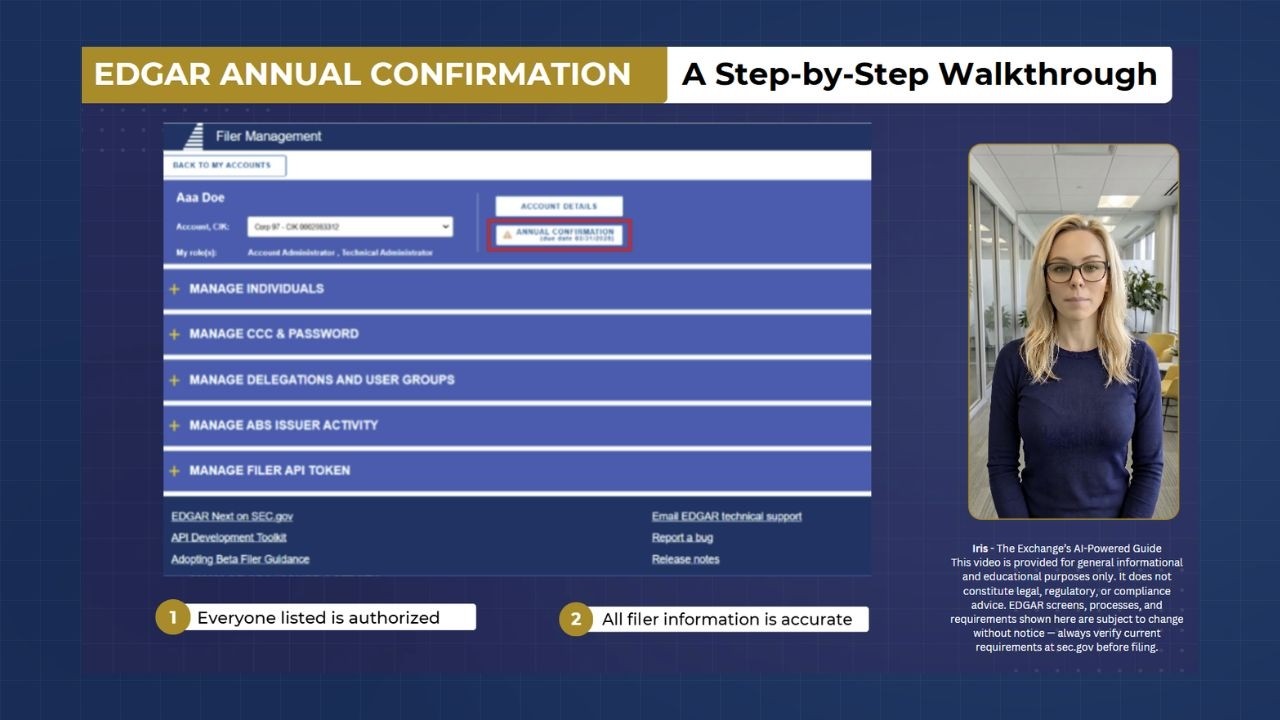
The obligation is easy to overlook precisely because nothing gets filed. Each filer must confirm, on its EDGAR Filer Management dashboard, that the users, account administrators, technical administrators and delegated entities listed there are still authorized to act on the filer's behalf, and that all information shown for the filer is accurate. Any one of the filer's account administrators can complete it. EDGAR sends reminder emails and dashboard notifications starting six weeks out, and the due date appears at the top of the dashboard.
Miss it and reminders continue each business day. If the confirmation is not completed within the three month grace period, the account is deactivated, and restoring access requires a new Form ID. The practical risk is that a deactivated account does not announce itself. Companies find out the day a 10-Q, an 8-K or a Section 16 report is due, which is the worst possible moment to start a Form ID application. sec.gov →
|
|
|
|
New Training Video · Presented by IRIS
EDGAR Annual Confirmation: A Step-by-Step Walkthrough
Iris walks through the Filer Management dashboard: where the Annual Confirmation button sits, how to read the due date shown next to it, and what to review under Manage Individuals and Manage Delegations before you confirm.
Watch on YouTube ▶
|
|
|
Explore more at the EDGAR Resource Center →
|
|
Before You Confirm
Three Things Worth Checking This Month
| 1. |
Your account administrators. Confirm who they are and confirm both still work at the company. Departures are the single most common reason a confirmation goes unperformed. |
| 2. |
Your delegated entities. If you changed filing agents or securities counsel in the past year, the former entity may still hold delegated filing authority on your dashboard. |
| 3. |
Your Section 16 filers. Officers and directors each hold their own EDGAR accounts with their own confirmation dates. These are frequently orphaned when someone leaves the board. |
|
|
| Policy Watch · Digital Assets |
|
|
Legislation · Procedural Vote September 15
The CLARITY Act Finally Has a Date
Last month we reported the bill was down to the wire. It went past the wire. The Senate adjourned on August 8 without voting, but Majority Leader John Thune filed cloture on the motion to proceed before leaving town. That single procedural step is what separates September from the eight months of stalemate that preceded it: there is now a date on the calendar. The Senate returns September 14 and the first vote is set for September 15.
Be clear on what that vote is. It is cloture on the motion to proceed, which limits debate and clears the way for the Senate to take the bill up. It is not passage. Invoking cloture requires 60 votes, and with Republicans holding 53 seats the motion needs at least seven Democrats or independents assuming every Republican votes in favor.
Negotiators have still not closed on government ethics provisions, illicit finance safeguards, or how the Senate Agriculture Committee text folds into the final bill. The calendar is the binding constraint: the Senate has roughly three weeks in session before attention turns to the November midterms. As we said last month, we will report what actually passes. congress.gov →
|
|
|
Rulemaking · Proposed August 18
The SEC Chose Rulemaking Over Exemption
Two things happened at the SEC in the same week, and the order matters. On August 14 the Commission scrapped a scheduled open meeting on its tokenization innovation exemption. Reporting attributed the retreat in part to concern that acting unilaterally would complicate the CLARITY negotiations on the Hill. Four days later, on August 18, the Commission proposed Regulation Crypto Assets through ordinary notice-and-comment rulemaking instead.
The substance is the first offering framework built for token issuers rather than retrofitted from rules written for traditional securities. A startup exemption would permit offerings of up to $5 million over four years. A fundraising exemption modeled on Regulation A, structured in two tiers, would permit up to $20 million or up to $75 million in any 12-month period, with financial statements and ongoing reporting attached to the larger tier. If you already understand Regulation A, you already understand the shape of this.
The quieter provision may matter more than the dollar thresholds. A conditional safe harbor would let a crypto asset cease to be subject to an investment contract once the issuer completes the managerial efforts it promised. That is a proposed answer to the question a decade of litigation has not settled: when does a token stop being a security?
Two cautions and one date. This is a proposal, not a rule. Neither exemption is available today, and the antifraud and antimanipulation provisions apply regardless. The date is October 20, 2026, when the comment period closes. Anyone can file a comment, issuers included, and few OTC companies ever do. If this framework would touch your business, this is the window. sec.gov →
|
|
|
TXSE Watch
September looks like TXSE's next milestone month. The exchange's launch guide targets the first ETP listing for September 2026 and the first corporate listing for October 2026. August announcements included Texas Capital's TXS and OILT as the first primary listings, Westwood's Salient Enhanced Power & Infrastructure ETF as the first new ETF on TXSE, and Brookmont Catastrophic Bond ETF's scheduled move from NYSE Arca on September 18. For operating companies, October is still the date that matters. txse.com →
|
|
|
|
| |
|
The Exchange Wants to Hear From You
Tell us what you'd like to see more of. Click your top pick below.
|
|
|
|
|
Connect With Us
© 2026 The Exchange LLC. The Exchange LLC provides strategic advisory services only and does not act as a broker-dealer, underwriter, investment advisor, or legal counsel. This publication is for informational purposes only and does not constitute investment, legal, accounting, or financial advice.
|
|