|
PUBLIC MARKET INSIGHTS
June 2026
|

|
|
|
A monthly briefing on public market readiness, regulatory change, and the steps from OTC Markets to the national exchanges.
From The Exchange · June 2026
June brings significant regulatory movement across multiple fronts. The SEC has proposed its most sweeping registered offering reforms in over 20 years. The CLARITY Act cleared the Senate Banking Committee. OTC Markets is positioning itself at the center of the tokenization conversation. And this issue we look at a risk many OTC companies overlook — the 15c2-11 cliff and what it means for your public market.
|
|
|
|
SEC Proposal · Offering Reform
SEC Proposes Most Significant Registered Offering Reforms in Over 20 Years
On May 19, 2026, the SEC proposed two additional rulemakings commonly referred to as the Registered Offering Reform Proposal and the Filer Status Proposal. These proposals would amend Securities Act and Exchange Act rules and forms to enhance companies' ability to conduct registered offerings, simplify filer-status categories and extend scaled disclosure and reporting requirements to additional issuers, with a particular focus on smaller and mid-sized public companies. In public statements, SEC leadership has framed this rulemaking package as part of a broader effort to promote capital formation and reduce unnecessary regulatory burdens in U.S. public markets.
| Shelf Registration Access Any public company can access shelf offerings regardless of public float. |
| Filer Status Threshold Raised Large accelerated filer threshold rises from $700 million to $2 billion. |
| 60-Month IPO On-Ramp Newly public companies receive a minimum five-year grace period before accelerated filer status applies. |
| Extended Disclosure Scaling Scaled accommodations extended to approximately 81% of all current public companies. |
| Blue Sky Preemption State registration requirements preempted for all registered offerings. |
SEC Proposal · Reporting Reform
SEC Formally Proposes Optional Semiannual Reporting — Comment Deadline July 6, 2026
On May 5, 2026, the SEC proposed amendments that would permit Exchange Act registrants to elect semiannual reporting on new Form 10-S instead of filing three quarterly reports on Form 10-Q, with comments due July 6, 2026. The election would be optional and made annually, and companies that do not elect it would continue to file quarterly reports under the current framework.
For OTC-traded SEC registrants, this may ultimately reduce reporting cadence without changing core disclosure content. OTCQB and OTCQX eligibility criteria focus on issuers being current and timely in required disclosure, and their frameworks already contemplate semiannual reporting for some issuers. Final impacts for Exchange Act registrants that elect semiannual reporting will depend on the adopted SEC rule text and how OTC Markets updates and interprets its eligibility criteria.
| Action item: The comment period closes July 6, 2026. OTC issuers, market makers, and broker-dealers should consider submitting comments given the direct implications for OTC tier disclosure standards. |
Read the SEC Press Release →
|
|
|
| |
Policy Spotlight · CLARITY Act |
|
|
Legislative Update · Digital Assets
CLARITY Act Clears Senate Banking Committee in Historic 15-9 Vote
On May 14, 2026, the Senate Banking Committee advanced the Digital Asset Market Clarity Act in a 15-9 bipartisan vote, sending it to the full Senate floor. All 13 Republican members voted in favor, joined by Democrats Ruben Gallego of Arizona and Angela Alsobrooks of Maryland.
| |
What happens next: The bill needs 60 votes to overcome a Senate filibuster. The White House has set July 4 as its target for a presidential signature. A companion bill cleared the Senate Agriculture Committee in January 2026, meaning the two versions will need to be reconciled before final passage. |
For OTC-traded companies with digital asset exposure or dual-asset structures, the bill is intended to provide a clearer allocation of responsibilities between the SEC and the CFTC, including the treatment of certain digital commodities. Even if the legislation is enacted in 2026, the most consequential requirements for issuers and intermediaries are unlikely to become effective before 2027, given the extensive agency rulemaking and coordination that would follow.
|
|
15-9
Committee vote
bipartisan passage
|
60
Senate votes needed
to clear filibuster
|
2026
Target year
uncertain timing
|
|
|
|
|
|
| The CLARITY Act, Tokenization & Public Markets |
The Exchange LLC
Editorial |
|
| Q |
The CLARITY Act just cleared the Senate Banking Committee. Why should OTC companies and their advisors be paying attention? |
| A |
The CLARITY Act is primarily a digital asset bill, but its implications extend well beyond cryptocurrency companies. At its core, it draws a clear jurisdictional line between the SEC and the CFTC over which agency regulates which type of digital asset. For public companies, that clarity matters because it determines disclosure obligations, trading rules, and investor protection requirements. Any OTC company that has issued, is considering issuing, or holds digital assets needs to understand where those assets fall under this framework. Equally important: the CLARITY Act is expected to unlock a wave of rulemaking from both agencies that will shape how tokenized securities are issued, traded, and reported going forward. |
|
| Q |
What is tokenization, in plain terms, and why does it matter for OTC markets specifically? |
| A |
Tokenization is the process of representing ownership of a real-world asset, such as a share of stock, on a blockchain as a digital token. Think of it as a digital receipt that proves you own the underlying asset. In a fully tokenized environment, the potential benefits for OTC markets include 24/7 trading windows unconstrained by traditional market hours, fractional ownership down to very small denominations, and settlement in seconds rather than the current T+1 cycle. These are potential capabilities, not yet live for OTC shares. OTC Markets Group received regulatory approval for broker-dealers to trade digital asset securities on OTC Link ATS, though the regulatory framework and key infrastructure needed for companies to actually issue blockchain-native securities tokens and for brokers to trade them are still not in place. OTC Markets management has named tokenized and digital assets as a strategic priority for 2026, investing in infrastructure and regulatory readiness. The framework to make this broadly viable is still being built, which is exactly why the CLARITY Act matters so directly. |
|
| Q |
Could tokenization allow investors to convert or transfer stock holdings in new ways? |
| A |
This is one of the more forward-looking aspects worth understanding early. In a tokenized market, smart contracts could theoretically allow investors to convert one tokenized security into another directly without going through a traditional broker, without waiting for T+1 settlement, and without the friction of today's clearing infrastructure. OTC Markets has proposed a structure modeled after American Depositary Receipts, where tokenized receipts backed by real shares could be issued without rewriting a company's corporate records. Whether these conversions constitute a securities transaction, how they would be taxed, and how custody would work are all questions the CLARITY Act rulemaking process will need to answer. Companies should not act on any of this today, but those with cross-listed or international securities structures should be watching closely. |
|
| Q |
What should OTC companies actually do with this information right now? |
| A |
At this stage, the most valuable thing a company can do is stay informed and ensure legal and compliance teams are tracking the rulemaking process that will follow the CLARITY Act. No company should be restructuring around tokenization without specific legal guidance. But companies that understand the direction of the market early will be better positioned to act when the frameworks are finalized. |
|
|
|
Be Featured in Public Market Insights
Each issue features a conversation with an industry expert: advisors, issuers, and professionals navigating the public markets. Interested in being featured? Email us at info@theexchangellc.com |
|
|
| |
Digital Markets · Crypto & Digital Assets |
|
|
In Focus · Digital Assets
The CLARITY Act & Tokenization: How America Is Redrawing the Map for Digital Finance
|
|
The CLARITY Act. The Digital Asset Market Clarity Act (H.R. 3633) passed the House in July 2025 with a bipartisan 294-134 vote. On May 14, 2026, the Senate Banking Committee advanced the bill in a 15-9 vote, sending it to the full Senate floor. In the Senate, the bill will generally need 60 votes to overcome a filibuster, and its final form and timing remain uncertain. A related measure addressing the CFTC's role advanced through the Senate Agriculture Committee earlier this year, and those approaches are expected to be reconciled before any final vote. Market commentators currently view the probability of some CLARITY-style legislation passing in 2026 as elevated but by no means assured.
Tokenization is already happening. While Congress debates the framework, large financial institutions and market utilities are moving ahead with tokenized products and infrastructure. Public estimates place tokenized Treasury and money-market products on public blockchains in at least the mid-single-digit billions of dollars as of 2025, up from well under $1 billion two years earlier. J.P. Morgan has arranged notable tokenized debt transactions, including U.S. commercial paper for Galaxy Digital on the Solana public blockchain with settlement in USDC. In December 2025, SEC staff granted a No-Action Letter to The Depository Trust Company (DTC), a DTCC subsidiary, permitting it to operate a platform for tokenizing certain real-world assets held in custody, and DTCC has since outlined plans to connect this infrastructure to the Stellar public blockchain over the next several years. Senior executives at major asset managers, including BlackRock's Larry Fink, have publicly compared the long-term potential of tokenization to the early days of the internet.
What it means for capital markets. Tokenization turns illiquid assets private equity stakes, real estate, corporate bonds into programmable, tradeable instruments. For smaller issuers, this is a potential new capital formation pathway: fractional ownership, 24/7 markets, and global investor access without the friction of traditional exchange listing.
|
House Vote
294–134 ✓ Passed
|
|
Tokenized T-Bills
$7–8B+ tokenized Treasuries on-chain
|
|
Senate Status
Headed to Senate Floor
|
|
|
|
|
|
|
Action Item · Fee Update
|
|
OTCID Annual Fee Increasing July 1, 2026
OTC Markets Group has notified subscribers that the OTCID annual fee will increase from $7,500 to $8,040 effective July 1, 2026. The updated rate applies to renewal invoices for service beginning on or after that date. Companies on the OTCID Basic Market should account for the change in their next budget cycle.
|
| • |
OTC Markets
OTC Markets Group has opened a new Hong Kong office, deepening its Asia-Pacific presence at what the company describes as a pivotal moment for cross-border capital markets. Asia-Pacific cross-traded dollar volume on OTC Markets reached $206.6 billion in 2025, up 53.4% year over year and the highest growth rate of any region. The office supports issuer outreach and 24x5 market access for investors and issuers across the region. JP Chan has been appointed Senior Vice President and Asia-Pacific Head to lead the effort.
|
| • |
OTCQX Upgrades
Active Month of OTCQX Upgrades in May
Several companies upgraded to OTCQX in May including CoTec Holdings (CTHCF), Forte Minerals (FOMNF), and Evolve Royalties (EVRYF). Each reflects continued momentum from international companies seeking U.S. investor visibility through the OTCQX Best Market.
|
|
| |
Advisory Perspective · From The Exchange |
|
|
Rule 15c2-11 · OTC Compliance
The 15c2-11 Cliff: How Companies Lose Their Public Market
Why Waiting Too Long Can Be a Costly Mistake
For many OTC companies, maintaining an active public market is something that is simply expected. Management focuses on growing the business, raising capital, pursuing acquisitions, and building shareholder value, often assuming the public market will always be there when they need it.
Unfortunately, that is not always the case. Every year, companies find themselves approaching what many in the industry refer to as the "15c2-11 Cliff" — the point at which quotation eligibility may be lost due to missed disclosures, delinquent reporting, corporate inactivity, or other compliance issues. Without an active quotation, shareholder liquidity may be impacted, raising capital can become more difficult, acquisition opportunities may be limited, and the overall value of the public company vehicle can be affected.
|
Common Warning Signs
• Delayed or missing financial disclosures
• Questions regarding current reporting status
• Corporate inactivity or outdated public information
• Difficulty obtaining broker-dealer sponsorship
• Plans to raise capital, complete acquisitions, or pursue an uplisting
|
Prevention is usually easier than restoration. One of the most common mistakes management teams make is assuming they can address compliance concerns later. In reality, waiting until quotation eligibility is lost can often increase both the time and cost required to regain compliance. A proactive review of a company's status can help identify potential issues before they become obstacles to future growth plans.
For many issuers, Rule 15c2-11 is more than just a regulatory requirement. It is a key component of maintaining an active public market and preserving future strategic opportunities. Understanding where your company stands today may help prevent a much larger challenge tomorrow.
|
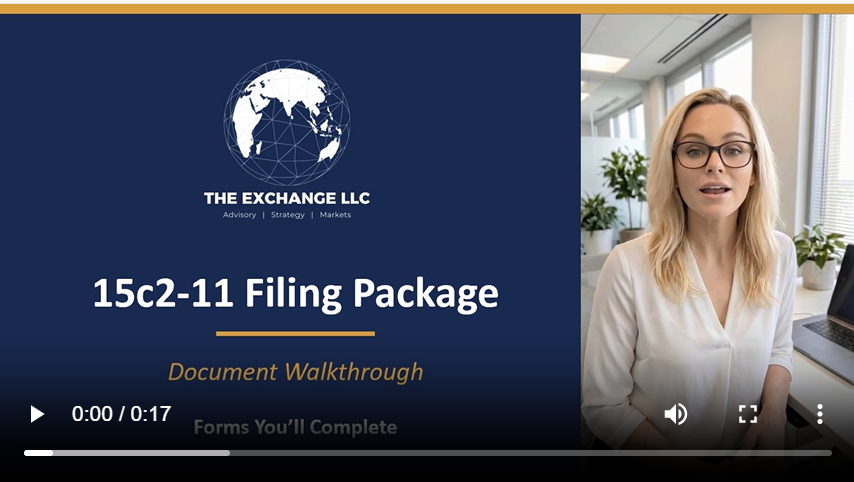
Is Your Company at Risk?
The Exchange LLC provides strategic advisory services to public and private companies navigating quotation eligibility, reporting pathways, OTC Markets positioning, and public company readiness. Confidential inquiries welcome.
|
 View the Process →
|
|
|
|
|
|
|
|
|
| The CLARITY Act cleared the Senate Banking Committee 15-9 on May 14. It now needs 60 Senate votes to overcome a filibuster. The White House is targeting a July 4 signing. |
| The SEC formally proposed optional semiannual reporting on May 5. Companies could elect to file twice per year instead of quarterly. Comment deadline: July 6, 2026. |
| OTC Markets Group opened a new Hong Kong office, as Asia-Pacific cross-traded volume reached $206.6 billion in 2025, up 53.4% year over year and the highest growth rate of any region. |
|
|
Sponsored
|
Investor Marketing for Emerging Public Companies
TDM Financial is a data-driven investor marketing firm with over 15 years of experience helping emerging public companies in the U.S. and Canada attract and retain the right investors at scale. Operators of SECFilings.com and the CFN Media ecosystem.
Learn More
|
|
| Coming Next Issue |
Market Structure |
|
|
The Texas Stock Exchange is tracking toward a summer 2026 launch as the first new national securities exchange approved by the SEC in decades. Key elements of the TXSE model that OTC companies and advisors should understand:
| ■ All-electronic. No physical trading floor. Primary data center in New Jersey with supporting facilities in Dallas and Chicago. TXSE has signed a lease at Bank of America Tower in Dallas as its headquarters and is reportedly planning a cannon blast instead of a bell to open and close trading. |
| ■ Strict listing standards. CEO Jim Lee has stated that approximately 1,500 of today's 4,400 public companies would fail TXSE's continued listing standards. TXSE requires a minimum market cap of $200 million and a bid price of $4.00 per share for at least 90 consecutive trading days. |
| ■ Day-one trading without formal listings. Many investors assume a stock only trades where it is formally listed. In reality, when TXSE launches, investors may see familiar household-name stocks trading there immediately — TXSE can trade many already-listed public companies from day one through existing market structure rules. |
| ■ Texas is becoming a capital markets hub. NYSE Texas launched in 2025 and Oracle, Tesla, and other major companies have relocated headquarters to Texas. TXSE is entering a market that is rapidly reshaping U.S. capital markets geography. |
txse.com →
|
|
|
The Exchange Wants to Hear From You
Tell us what you'd like to see more of click your top pick below.
|
|
|
|
|
|
About The Exchange
The Exchange provides strategic guidance to companies progressing through the public market pipeline from OTC disclosure to exchange readiness. Learn more at theexchangellc.com
© 2026 The Exchange LLC. This publication is for informational purposes only and does not constitute investment, legal, accounting, or financial advice. The Exchange is not a registered broker-dealer, investment adviser, or law firm. Information reflects conditions as of publication and may change without notice. Readers should perform independent due diligence and consult qualified professionals before acting on any information.
|
|