| |
|
July 4, 1776 – July 4, 2026
Happy Independence Day
America Turns 250
America's Block Party is happening July 3–5 in cities across the country. The Navy's International Fleet Review brings 60 ships from 30 nations into New York Harbor on July 4. Philadelphia, Boston, and Washington D.C. are hosting flagship national events. And 5 million World Cup visitors are already on the ground, many seeing America for the very first time.
Scroll down for the special edition ↓
|
| |
| |
|
|
PUBLIC MARKET INSIGHTS
July 2026 · Special Edition
America's 250th Anniversary
|

|
|
| |
Independence Day · Filing Reminder |
|
EDGAR Closed Friday, July 3
July 4 falls on a Saturday this year. Under 5 U.S.C. § 6103(b), when a federal holiday lands on a Saturday, the observed holiday shifts to the preceding Friday. EDGAR will not accept filings on July 3. Plan accordingly, then enjoy the long weekend.
|
|
|
|
|
|
Small Business Capital Formation
Joseph Lucosky, Managing Partner of Lucosky Brookman LLP, was appointed to the SEC's Small Business Capital Formation Advisory Committee on June 10, 2026, one of five new members named by SEC Chairman Paul S. Atkins to four-year terms. The Committee advises the Commission directly on capital formation, IPO activity, and regulatory issues affecting smaller public companies.
|
|
|
|
|
|
Exchange Launch · July 6, 2026
Texas Stock Exchange Targeting July 6 Launch
A new national exchange beginning trading in America's 250th year is a fitting marker of how the country's capital markets keep evolving. TXSE is moving into launch mode. Its member readiness guide targets trading to begin on July 6, 2026 in specified test stocks, with connectivity, testing, and certification milestones leading up to go-live. TXSE says the launch is the first step in a broader rollout that later includes ETP and corporate listings. txse.com →
|
|
|
|
|
|
Market Nugget · SpaceX IPO
555,555,555: The Number Behind the Largest IPO in History
The largest IPO in history pricing in America's 250th year is a fitting marker of how far American capital markets can carry a company. SpaceX began trading on Nasdaq in June 2026 under ticker SPCX, raising $75 billion in the largest IPO ever recorded. Priced at $135 per share. But the number worth remembering is the share count: exactly 555,555,555 shares. Not approximate. Exact. The repeating fives were deliberately engineered so the arithmetic would land precisely on $75 billion. The total raise came to $74,999,999,925, just $75 short of a round number. The greenshoe option followed the same logic: 83,333,333 shares. Intentional elegance built into the deal structure from the start.
Before any of that, SpaceX raised capital for over two decades exclusively through Regulation D private offerings. Its Form D filings on SEC EDGAR are public record, a useful illustration of what Reg D filings actually look like. No financials, no deal terms, no valuation. Just a notice that a raise occurred. The private-to-public path SpaceX took is its own story, but the Reg D starting point is one that many companies share.
| By the numbers: $75B raised · 555,555,555 shares · $135/share · $1.77T valuation (approx.) · Nasdaq: SPCX |
|
What Happens Next · July 7, 2026
SpaceX Joins the Nasdaq-100
Nasdaq announced on June 26 that SPCX will become a component of the Nasdaq-100 before market open on July 7, 2026, just 15 trading days after its IPO. This is possible under Nasdaq's new "fast entry" rule, adopted in March 2026 and effective May 1, which allows large IPOs ranking within the top 40 Nasdaq-100 constituents by market cap to skip the previous three-month seasoning requirement and enter the index after just 15 trading days. The mechanical impact is significant: passive investors in index funds and ETFs like QQQ are estimated to purchase up to $4.3 billion in SPCX shares from the Nasdaq-100 inclusion alone. SpaceX was also added to the Russell 1000 and Russell Top 200, effective at the June 29 market open, under FTSE Russell's fast-entry rule, which triggered additional passive buying. Worth noting for balance: SpaceX posted a net loss of $4.9 billion last year, and it remains ineligible for the S&P 500, which kept its stricter profitability requirements unchanged after a June 4 consultation. Nasdaq-100 index funds will begin buying after the close on July 6.
|
|
|
|
|
|
Private Offerings · Capital Formation
Reg D Still Drives Private Capital
Before companies ever reach a public market, many start with a private raise under Regulation D. The SEC's Reg D framework, primarily Rules 504, 506(b), and 506(c), allows companies to raise capital from accredited investors without registering the offering publicly. Rule 504 covers raises up to $10 million in a 12-month period; Rule 506 offerings can raise unlimited amounts. Companies must file a Form D notice with the SEC within 15 calendar days of the first sale. Form D filings are public record on SEC EDGAR and are often an early signal of where private capital is flowing, useful context for advisors tracking companies that may later pursue OTC trading or a public-market path.
|
Thinking About the Next Step?
The Exchange LLC works with private companies navigating the path from Reg D to OTC Markets and beyond. Contact us to discuss your options.
|
Contact Us →
|
|
|
|
|
| |
|
⚽ The World Cup Effect
Five Million Visitors. One Economic Moment.
The 2026 FIFA World Cup is being played across the United States, Canada, and Mexico, with the U.S. hosting the majority of matches, including the final at MetLife Stadium in New Jersey. It is the first World Cup since 1994 to be hosted in North America, and the largest in history with 48 teams and 104 matches. Estimates put total economic impact for the U.S. at over $5 billion, with an expected 5 million international visitors arriving throughout the tournament.
But the story that has captured the most attention is not on the field. It is on social media. Across TikTok, Instagram, and X, international visitors are posting videos that have generated millions of views, not of the soccer but of ordinary American life. A Swedish tourist screaming with excitement when she spotted a yellow school bus. A German fan going viral after visiting Buc-ee's, a Waffle House, and a Texas stadium, eventually drawing shoutouts from Transportation Secretary Sean Duffy and former NFL star J.J. Watt. Scottish supporters filling Boston's streets with bagpipes at 6:30 in the morning, and the neighbors loving it. A Japanese soccer journalist comparing Nashville to Universal Studios.
One British supporter captured the sentiment in a widely shared video: "We owe America a huge apology because America is nothing like the media tells us. Everyone is so friendly, everyone is so accommodating, and I've honestly had the best time."
That inbound wave is arriving in a country also celebrating its 250th anniversary. For investors and market watchers, it is not just a cultural moment. Travel, lodging, dining, retail, transportation, and the local economies that host these visitors are all in focus. It is a real economic event with measurable sector-level tailwinds, and a reminder that firsthand experience often tells a different story than the news cycle.
|
| |
|
|
| |
The Next 250 · America's Digital Capital Ambition |
|
| |
|
America · Capital Markets · 250th
The Crypto Capital of the World
The thread running through 250 years of American capital markets is simple: America builds the rules, then builds the markets. The Buttonwood Agreement. The Securities Exchange Act of 1934. Nasdaq in 1971. Each era, America set the framework and the world followed.
That pattern is now extending into digital market infrastructure. In May, DTCC announced that DTC's new tokenization service is scheduled to begin limited production trades in July 2026, with more than 50 firms participating and a broader launch planned for October. The pilot is designed to support tokenized securities within the existing post-trade framework, signaling that the same core plumbing behind traditional U.S. capital markets is being adapted for the next era of issuance, custody and settlement.
Digital assets are no different. The White House has made it explicit: the United States intends to be the crypto capital of the world. President Trump signed executive orders in early 2025 establishing a Strategic Bitcoin Reserve and directing federal agencies to remove barriers to digital asset development. The CLARITY Act, which cleared the Senate Banking Committee 15-9 in May, would establish the first comprehensive U.S. framework for digital asset jurisdiction, drawing a clear line between the SEC and the CFTC and giving the industry something it has never had: legal clarity. Whether that bill passes in 2026 or later, the direction is set. America is not ceding this market.
For companies and advisors in the public markets, that matters. The same infrastructure that supports OTC trading and national exchange listings is being positioned to support tokenized securities. SpaceX went public. TXSE is launching. The CLARITY Act is on the Senate floor. The next chapter of American capital formation is being written now, and it looks a lot like the chapters before it.
|
| |
|
| |
America's 250th · The Markets That Built America |
|
The Markets That Built America
25 capital market milestones across 250 years, from the Buttonwood Agreement to SpaceX.
|
1
|
1792: The Birth of Wall Street. Twenty-four brokers signed the Buttonwood Agreement under a buttonwood tree in New York City, laying the foundation for what became the NYSE. |
|
2
|
The NYSE Is Older Than the White House. The NYSE traces its origins to 1792. The White House was not completed until 1800. |
|
3
|
America's First Market Panic Occurred in 1792. Just months after the Buttonwood Agreement, speculation led to the Panic of 1792, the first financial crisis in U.S. history. |
|
4
|
Railroads Were the Growth Stocks of the 1800s. Railroad companies raised enormous amounts of capital and helped create the modern securities industry. |
|
5
|
The First Stock Ticker Appeared in 1867. Edward Calahan's stock ticker allowed investors to receive near real-time market prices over telegraph lines. |
|
6
|
Ticker Symbols Got Their Name from the Ticker Machine. The machines printed stock prices on paper tape while making a distinctive ticking sound. |
|
7
|
Ticker-Tape Parades Were Once Literal. Workers in financial districts tossed used ticker tape from office windows during celebrations. |
|
8
|
The Dow Jones Industrial Average Began in 1896. The original Dow consisted of just 12 industrial companies. |
|
9
|
Charles Dow Created the Dow Average Before Calculators Existed. The average was calculated by hand and published in newspapers. |
|
10
|
General Electric Was the Last Original Dow Component. GE joined the original Dow in 1896 and remained part of the index for more than 120 years before leaving in 2018. |
|
11
|
Coca-Cola Went Public in 1919. Shares were offered to the public at $40 per share. |
|
12
|
The NYSE Closed for Four Months During World War I. The exchange shut down in July 1914 and remained closed until November, the longest closure in its history. |
|
13
|
The SEC Was Created in 1934. Congress established the Securities and Exchange Commission following the stock market crash and Great Depression. |
|
14
|
The First Billion-Dollar Corporation Was U.S. Steel. Formed in 1901, U.S. Steel became the world's first company valued at more than $1 billion. |
|
15
|
NASDAQ Launched in 1971. NASDAQ became the world's first electronic stock market. |
|
16
|
NASDAQ Originally Did Not Execute Trades. It started as an electronic quotation system; trades were still handled by market makers. |
|
17
|
Rule 15c2-11 Was Adopted in 1971. The SEC rule remains one of the most important regulations affecting OTC market quotations today. |
|
18
|
Apple's IPO Created Approximately 300 Millionaires. When Apple went public in December 1980, it created more millionaires at the time than any company since Ford. |
|
19
|
Microsoft Went Public in 1986. The company raised about $61 million in its IPO and became one of the most successful public companies in history. |
|
20
|
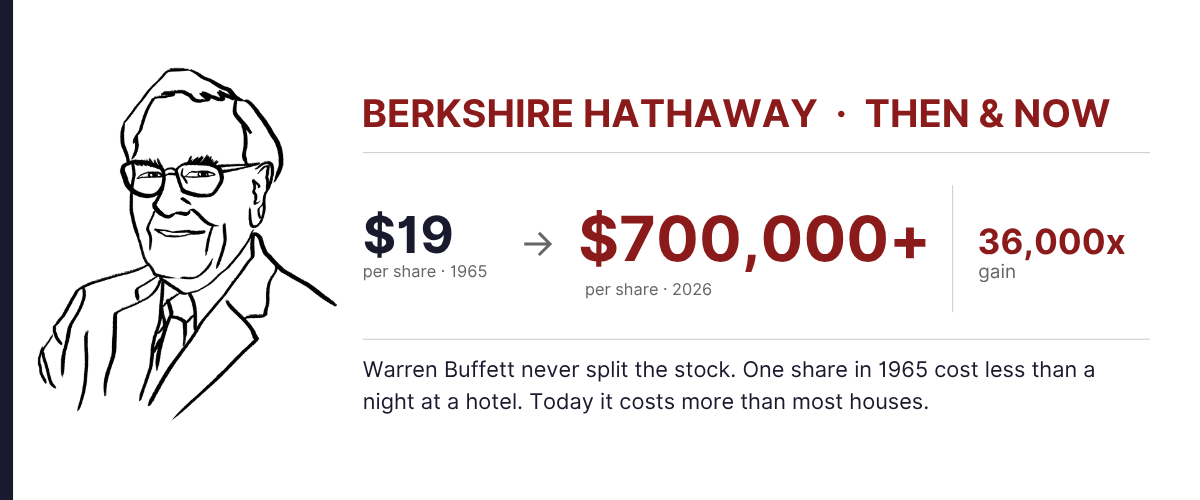
Warren Buffett Took Control of Berkshire Hathaway in 1965. Berkshire shares traded around $19 when Buffett assumed control. |
|
21
|
Berkshire Hathaway Has Never Split Its Class A Shares. The stock has grown from approximately $19 in 1965 to more than $700,000 per share today. |
|
22
|
Amazon Went Public in 1997. Its IPO price was $18 per share before multiple stock splits. |
|
23
|
Google Reinvented the IPO Process. Google's 2004 IPO used a Dutch auction designed to broaden investor participation. |
|
24
|
SpaceX Became One of the World's Most Valuable Private Companies Without an IPO. Founded in 2002, SpaceX raised billions privately through Reg D offerings while remaining outside the public markets until 2026. |
|
25
|
America's Capital Markets Continue to Evolve. From paper stock certificates and ticker tape to AI, blockchain, tokenization, and digital assets, the next chapter of capital formation is already underway. |
|
|
|
| |
|
For 250 years, America's capital markets have financed the nation's growth, from canals and railroads to automobiles, computers, the internet, artificial intelligence, and private space exploration. Every era of innovation has been powered by access to capital.
|
| |
|
|
|
|
© 2026 The Exchange LLC. This publication is for informational purposes only and does not constitute investment, legal, accounting, or financial advice.
|
|